
Exploring the Physical World

Before the Aliens, the Amino Acids

A Weizmann-led team proposes a simple but powerful new method for detecting traces of alien biology, whether on Jupiter’s icy moons, in meteorites, or in Martian samples. 

Before The Aliens The Amino Acids 1
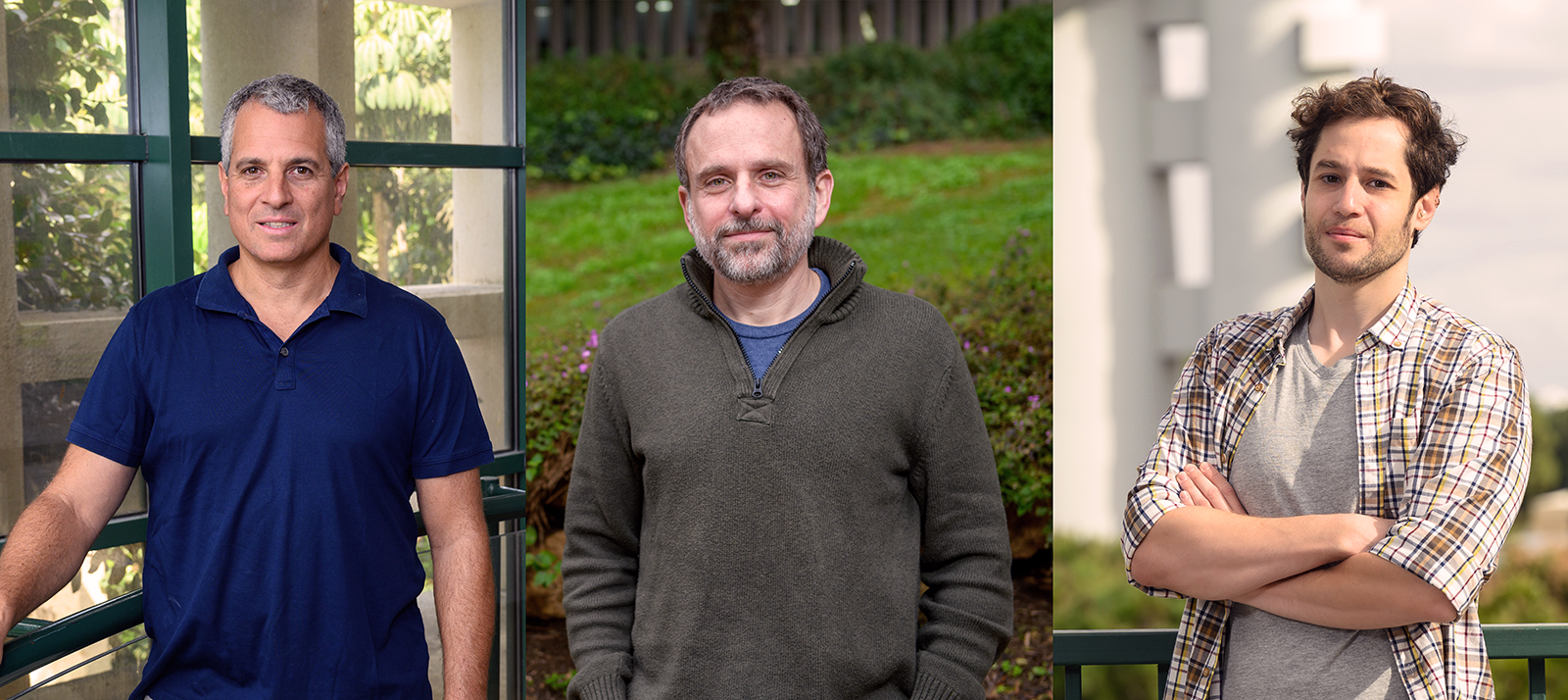
(l-r) Prof. Yohai Kaspi, Prof. Itay Halevy, and Dr. Gideon Yoffe

REHOVOT, ISRAEL — June 10, 2026 — Before any wrinkled, wide-eyed creature from a distant civilization asks to be taken home, the first success in the search for life beyond Earth might be more prosaic. A clue could emerge from a handful of molecules in a Martian rock, a grain of ice from a moon of Jupiter or Saturn, or a plume rising from an ocean sealed beneath a frozen shell.

In a study published in Nature Astronomy, an Israeli-US team led by researchers from the Weizmann Institute of Science has now defined a new kind of life’s signature. It could offer a relatively simple way to address the age-old question: Are we alone?

For decades, scientists have searched for biosignatures – chemical or physical traces that can act as fingerprints of life, helping distinguish living matter from nonliving chemistry. Some methods focus on the ratios of left- and right-handed molecules, others on isotope ratios. But interpreting such signals usually requires knowing how a sample formed and evolved, information that is rarely available. Spacecraft cannot carry every instrument that scientists would want, and extraterrestrial samples are seldom clean or complete. Radiation alters molecules, geology can imitate biology, and organic material can become degraded, mixed, or contaminated over time. The ultimate challenge is that “organic” does not automatically mean “alive”: Amino acids and other compounds can form through entirely nonbiological chemistry.

“The key value of our approach is that it offers an easy way to identify organic material that is biological, as opposed to just organic gunk that formed in the early solar system,” says Prof. Itay Halevy, who headed the research team together with Prof. Yohai Kaspi, both of Weizmann’s Earth and Planetary Sciences Department.

The study was led by Dr. Gideon Yoffe, a postdoctoral fellow in Kaspi’s lab, who brought together tools from statistics, ecology, and planetary science. The team also included Dr. Fabian Klenner of the University of California, Riverside, and Dr. Barak Sober of the Hebrew University of Jerusalem.

“Many current methods of searching for extraterrestrial life are limited because they require either complicated processing of organic material or highly specific analytical methods – work you currently cannot perform in outer space,” Yoffe says.

The new approach sidesteps these limitations by relying less on complicated chemistry and more on statistical patterns. It draws on a method that was originally developed by ecologists to characterize the diversity of animal species within habitats. Yoffe, whose background is in statistics and data science, adapted it to the field of astrobiology.

The central idea is to examine molecular diversity, with the understanding that life reorganizes chemistry according to function. Sometimes that means expanding diversity and sometimes narrowing it. Instead of focusing on individual molecules, the researchers looked at statistical patterns in groups of molecules – their spread and relative abundances. To test the method, the team analyzed more than 100 organic and inorganic samples, including material from three-billion-year-old Earth rocks, dinosaur eggshells, and fossilized dinosaur feathers caught in amber, as well as samples collected in space from the Ryugu and Bennu asteroids.

The study began with amino acids, the molecular building blocks of proteins. Amino acids can form naturally in the absence of life through collisions among simpler molecules, but because such collisions are rare in space, the likelihood of complex amino acids assembling in this way is limited. Therefore, in nonliving chemistry, simpler amino acids tend to dominate because they form more easily, while larger and more complex ones become increasingly rare. 

Life behaves differently. Living systems survive when they produce the molecules that enable their function, even if those molecules are energetically “expensive” to make. Instead of a random assortment shaped mainly by chance, biology therefore leaves behind patterns that are not necessarily dominated by simpler building blocks.

As a result, samples of living matter are consistently more diverse in terms of molecular composition than their nonliving counterparts. This distinction holds true not only for amino acids but also for fatty acids, indicating that the diversity signal reflects a fundamental biosynthetic signature.

“Life will produce the building blocks it needs in order to function,” sums up Halevy.  

The method was created in the context of a proposed Israeli mission concept called Eureka. Kaspi, Halevy, Yoffe, and collaborators are developing this concept together with Israel’s aerospace industry. The goal is to send a small spacecraft to one or two of the Solar System’s icy moons – likely Europa, and perhaps also Enceladus – whose frozen crusts conceal vast subsurface oceans. Taking part in planning the mission is the space division of Israel Aerospace Industries (IAI), which is leading the spacecraft’s design. 
Before The Aliens The Amino Acids 2
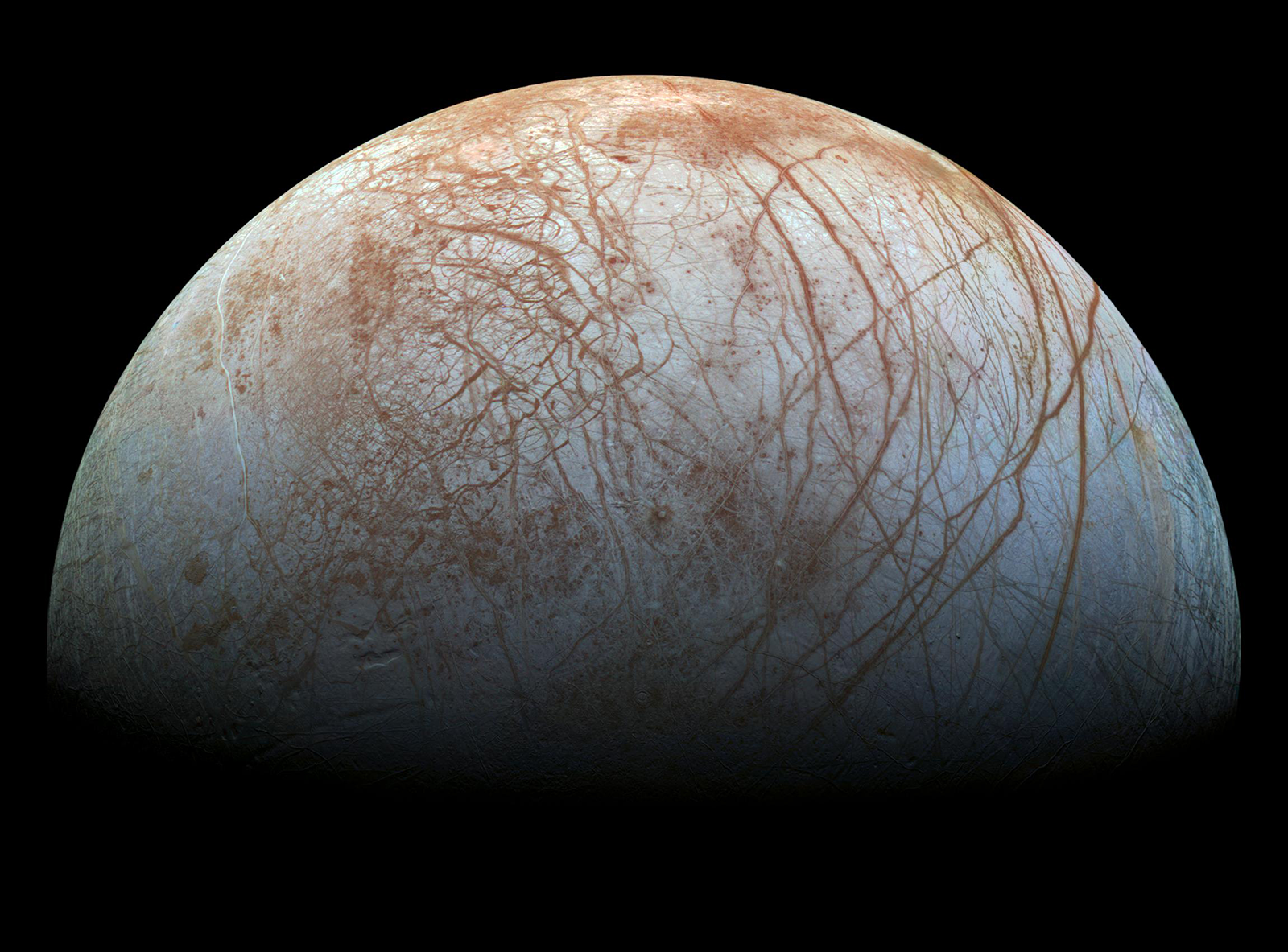
Europa, an icy moon of Jupiter whose subsurface ocean may harbor alien life. Credit: NASA/JPL-Caltech/SETI Institute

“These subterranean oceans are especially interesting because conditions there may permit the emergence of life,” says Kaspi. Future missions may be able to sample material from those oceans, including molecules produced near seafloor hydrothermal systems, similar to those on Earth.

“Our approach does not require fancy analytical instruments,” Kaspi explains. “It can be applied quite simply with any method capable of measuring relative abundances of different molecules, such as mass spectrometry.”

Still, the technique planned for the mission might sound to some like science fiction: fire a laser at alien ice and wait for molecules to glow back. The glow can help detect complex amino acids and other compounds that could carry biological signatures.

“I’ve been fascinated since childhood with anything connected to the search for life beyond Earth,” Yoffe says. “To me, this kind of detection would be one of the most exciting scientific discoveries ever made.” 

A major advantage of the method is that it can work even on samples with complicated histories – material altered by heat, radiation, time, or ice. “Space is a harsh environment, especially the vicinity of Jupiter, which has a powerful magnetic field, so energetic particles keep bombarding the surfaces of its moons,” Yoffe explains.

“Beyond its scientific importance and the possibility of discovering life beyond Earth, we see a space mission to the icy moons of Jupiter and Saturn as a source of educational inspiration for the next generation of Israeli scientists and engineers,” an IAI spokesperson said. “We are confident that every child who follows the spacecraft’s journey will be inspired to explore the universe and help lead Israel’s future breakthroughs in science and technology.”

The approach is not limited to icy moons. It could also be applied to meteorites, asteroid material, and samples of ancient Martian rocks. In a sense, the work brings together many branches of the search for alien life: telescopes reading starlight through distant atmospheres, spacecraft visiting asteroids and comets, meteorites arriving in earthly laboratories, and rovers drilling into ancient stone.

Discovering alien life would likely redefine what “first contact” means. There may be no voice and no greeting from the stars, at least not at first; the encounter could begin quietly, inside a dataset, through patterns in a collection of molecules. But it would be dramatic nonetheless.

“I’ve been fascinated since childhood with anything connected to the search for life beyond Earth,” Yoffe says. “To me, this kind of detection would be one of the most exciting scientific discoveries ever made.”

Prof. Itay Halevy’s research is supported by the Andre Deloro Prize for Scientific Research.

Prof. Yohai Kaspi’s research is supported by the Helen Kimmel Center for Planetary Science and the Knell Family Institute for Artificial Intelligence.


Exploring the Physical World

Before the Aliens, the Amino Acids

A Weizmann-led team proposes a simple but powerful new method for detecting traces of alien biology, whether on Jupiter’s icy moons, in meteorites, or in Martian samples. 

TAGS: Algorithms , Artificial intelligence , Astrophysics , Biochemistry , Biology , Chemistry , Earth , Mathematics , Space , Technology

Before The Aliens The Amino Acids 1
(l-r) Prof. Yohai Kaspi, Prof. Itay Halevy, and Dr. Gideon Yoffe

REHOVOT, ISRAEL — June 10, 2026 — Before any wrinkled, wide-eyed creature from a distant civilization asks to be taken home, the first success in the search for life beyond Earth might be more prosaic. A clue could emerge from a handful of molecules in a Martian rock, a grain of ice from a moon of Jupiter or Saturn, or a plume rising from an ocean sealed beneath a frozen shell.

In a study published in Nature Astronomy, an Israeli-US team led by researchers from the Weizmann Institute of Science has now defined a new kind of life’s signature. It could offer a relatively simple way to address the age-old question: Are we alone?

For decades, scientists have searched for biosignatures – chemical or physical traces that can act as fingerprints of life, helping distinguish living matter from nonliving chemistry. Some methods focus on the ratios of left- and right-handed molecules, others on isotope ratios. But interpreting such signals usually requires knowing how a sample formed and evolved, information that is rarely available. Spacecraft cannot carry every instrument that scientists would want, and extraterrestrial samples are seldom clean or complete. Radiation alters molecules, geology can imitate biology, and organic material can become degraded, mixed, or contaminated over time. The ultimate challenge is that “organic” does not automatically mean “alive”: Amino acids and other compounds can form through entirely nonbiological chemistry.

“The key value of our approach is that it offers an easy way to identify organic material that is biological, as opposed to just organic gunk that formed in the early solar system,” says Prof. Itay Halevy, who headed the research team together with Prof. Yohai Kaspi, both of Weizmann’s Earth and Planetary Sciences Department.

The study was led by Dr. Gideon Yoffe, a postdoctoral fellow in Kaspi’s lab, who brought together tools from statistics, ecology, and planetary science. The team also included Dr. Fabian Klenner of the University of California, Riverside, and Dr. Barak Sober of the Hebrew University of Jerusalem.

“Many current methods of searching for extraterrestrial life are limited because they require either complicated processing of organic material or highly specific analytical methods – work you currently cannot perform in outer space,” Yoffe says.

The new approach sidesteps these limitations by relying less on complicated chemistry and more on statistical patterns. It draws on a method that was originally developed by ecologists to characterize the diversity of animal species within habitats. Yoffe, whose background is in statistics and data science, adapted it to the field of astrobiology.

The central idea is to examine molecular diversity, with the understanding that life reorganizes chemistry according to function. Sometimes that means expanding diversity and sometimes narrowing it. Instead of focusing on individual molecules, the researchers looked at statistical patterns in groups of molecules – their spread and relative abundances. To test the method, the team analyzed more than 100 organic and inorganic samples, including material from three-billion-year-old Earth rocks, dinosaur eggshells, and fossilized dinosaur feathers caught in amber, as well as samples collected in space from the Ryugu and Bennu asteroids.

The study began with amino acids, the molecular building blocks of proteins. Amino acids can form naturally in the absence of life through collisions among simpler molecules, but because such collisions are rare in space, the likelihood of complex amino acids assembling in this way is limited. Therefore, in nonliving chemistry, simpler amino acids tend to dominate because they form more easily, while larger and more complex ones become increasingly rare. 

Life behaves differently. Living systems survive when they produce the molecules that enable their function, even if those molecules are energetically “expensive” to make. Instead of a random assortment shaped mainly by chance, biology therefore leaves behind patterns that are not necessarily dominated by simpler building blocks.

As a result, samples of living matter are consistently more diverse in terms of molecular composition than their nonliving counterparts. This distinction holds true not only for amino acids but also for fatty acids, indicating that the diversity signal reflects a fundamental biosynthetic signature.

“Life will produce the building blocks it needs in order to function,” sums up Halevy.  

The method was created in the context of a proposed Israeli mission concept called Eureka. Kaspi, Halevy, Yoffe, and collaborators are developing this concept together with Israel’s aerospace industry. The goal is to send a small spacecraft to one or two of the Solar System’s icy moons – likely Europa, and perhaps also Enceladus – whose frozen crusts conceal vast subsurface oceans. Taking part in planning the mission is the space division of Israel Aerospace Industries (IAI), which is leading the spacecraft’s design. 

Before The Aliens The Amino Acids 2
Europa, an icy moon of Jupiter whose subsurface ocean may harbor alien life. Credit: NASA/JPL-Caltech/SETI Institute

“These subterranean oceans are especially interesting because conditions there may permit the emergence of life,” says Kaspi. Future missions may be able to sample material from those oceans, including molecules produced near seafloor hydrothermal systems, similar to those on Earth.

“Our approach does not require fancy analytical instruments,” Kaspi explains. “It can be applied quite simply with any method capable of measuring relative abundances of different molecules, such as mass spectrometry.”

Still, the technique planned for the mission might sound to some like science fiction: fire a laser at alien ice and wait for molecules to glow back. The glow can help detect complex amino acids and other compounds that could carry biological signatures.

“I’ve been fascinated since childhood with anything connected to the search for life beyond Earth,” Yoffe says. “To me, this kind of detection would be one of the most exciting scientific discoveries ever made.” 

A major advantage of the method is that it can work even on samples with complicated histories – material altered by heat, radiation, time, or ice. “Space is a harsh environment, especially the vicinity of Jupiter, which has a powerful magnetic field, so energetic particles keep bombarding the surfaces of its moons,” Yoffe explains.

“Beyond its scientific importance and the possibility of discovering life beyond Earth, we see a space mission to the icy moons of Jupiter and Saturn as a source of educational inspiration for the next generation of Israeli scientists and engineers,” an IAI spokesperson said. “We are confident that every child who follows the spacecraft’s journey will be inspired to explore the universe and help lead Israel’s future breakthroughs in science and technology.”

The approach is not limited to icy moons. It could also be applied to meteorites, asteroid material, and samples of ancient Martian rocks. In a sense, the work brings together many branches of the search for alien life: telescopes reading starlight through distant atmospheres, spacecraft visiting asteroids and comets, meteorites arriving in earthly laboratories, and rovers drilling into ancient stone.

Discovering alien life would likely redefine what “first contact” means. There may be no voice and no greeting from the stars, at least not at first; the encounter could begin quietly, inside a dataset, through patterns in a collection of molecules. But it would be dramatic nonetheless.

“I’ve been fascinated since childhood with anything connected to the search for life beyond Earth,” Yoffe says. “To me, this kind of detection would be one of the most exciting scientific discoveries ever made.”

Prof. Itay Halevy’s research is supported by the Andre Deloro Prize for Scientific Research.

Prof. Yohai Kaspi’s research is supported by the Helen Kimmel Center for Planetary Science and the Knell Family Institute for Artificial Intelligence.