Exploring the Physical World

Slow Burn: The Faintest Supernova Ever Observed Refused to Fade 

An international team led by the Weizmann Institute of Science has discovered  that spectacular supernovae don’t always have a bright star behind them 

Slow Burn 1
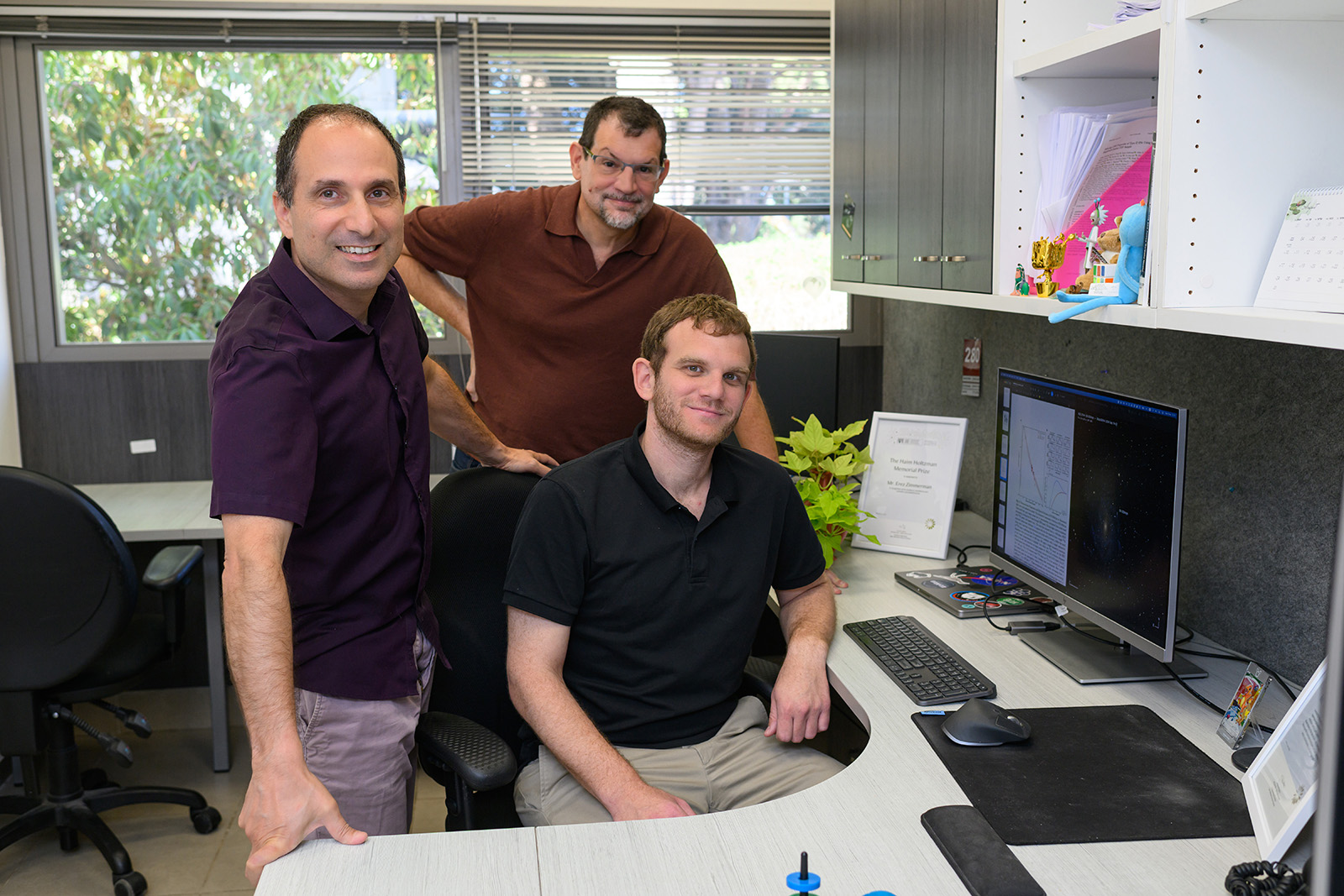
(l-r) Prof. Eran Ofek, Prof. Avishay Gal-Yam and Erez Zimmerman

REHOVOT, ISRAEL — November 26, 2026 — For the first few weeks after a star explodes in a supernova, it can shine as brightly as an entire galaxy of billions of stars. It’s tempting to assume that every spectacular supernova involves a brilliant star, but an international team of scientists who tracked the faintest supernova ever observed has shown that even dim stars can put on a dazzling finale. The findings of the new study, led by Prof. Avishay Gal-Yam’s group at the Weizmann Institute of Science and published today in Nature Astronomy, suggest that the relatively feeble explosion was the work of a binary system of small, dim stars. Faint supernovae are known to fade quickly, yet supernova SN 2024vjm faded slowly. The researchers have now revealed why, challenging an astrophysical principle that has stood firm for more than 30 years.

The best-known space telescopes, Hubble and James Webb, look at the universe as if through a drinking straw – they can see extremely far, but only a tiny sliver of the sky at any given moment. But catching a star in the act of exploding requires panoramic images: Such explosions occur only about once a century in a galaxy like our own, so astronomers must scan vast stretches of sky to spot them in distant galaxies. That, among other things, is what sky surveys are designed to provide. One of the most advanced, BlackGEM, which began operating in 2023 in Chile’s Atacama Desert, scans the southern sky. An international team has formed around it to study changes and transient phenomena.

“One autumn night two years ago, a minute before midnight GMT, BlackGEM recorded a new spot of light in the night sky,” says doctoral student Erez Zimmerman of Gal-Yam’s group, who led the new study. “When Prof. Paul Groot of Radboud University in the Netherlands reviewed the images the next morning, he spotted it and quickly alerted the international team through their group chat. The sudden appearance of a bright spot of light 30 million light-years away made us suspect it was a supernova, but it looked fainter than any supernova we had ever seen. Since a supernova is a transient event that reaches peak brightness within days to weeks, researchers around the world mobilized to quickly gather as much information about it as possible.”

The first measurement astrophysicists make when trying to understand a new phenomenon in the sky is of the spectrum of light reaching us from it. This reveals, among other things, which materials are present and how fast they are moving. “The results astounded us,” Zimmerman says. “In ordinary supernovae, the powerful explosion hurls into space a cloud of gas that expands at about 10,000 kilometers per second – but here the cloud was moving at only 3,000 kilometers per second. For a moment, we wondered whether we were witnessing some other kind of cosmic event.” Yet the composition of the material confirmed that this was indeed a supernova driven by nuclear fusion – much like a hydrogen bomb. So what kind of star had ended its life with such a whimper?
Slow Burn 2
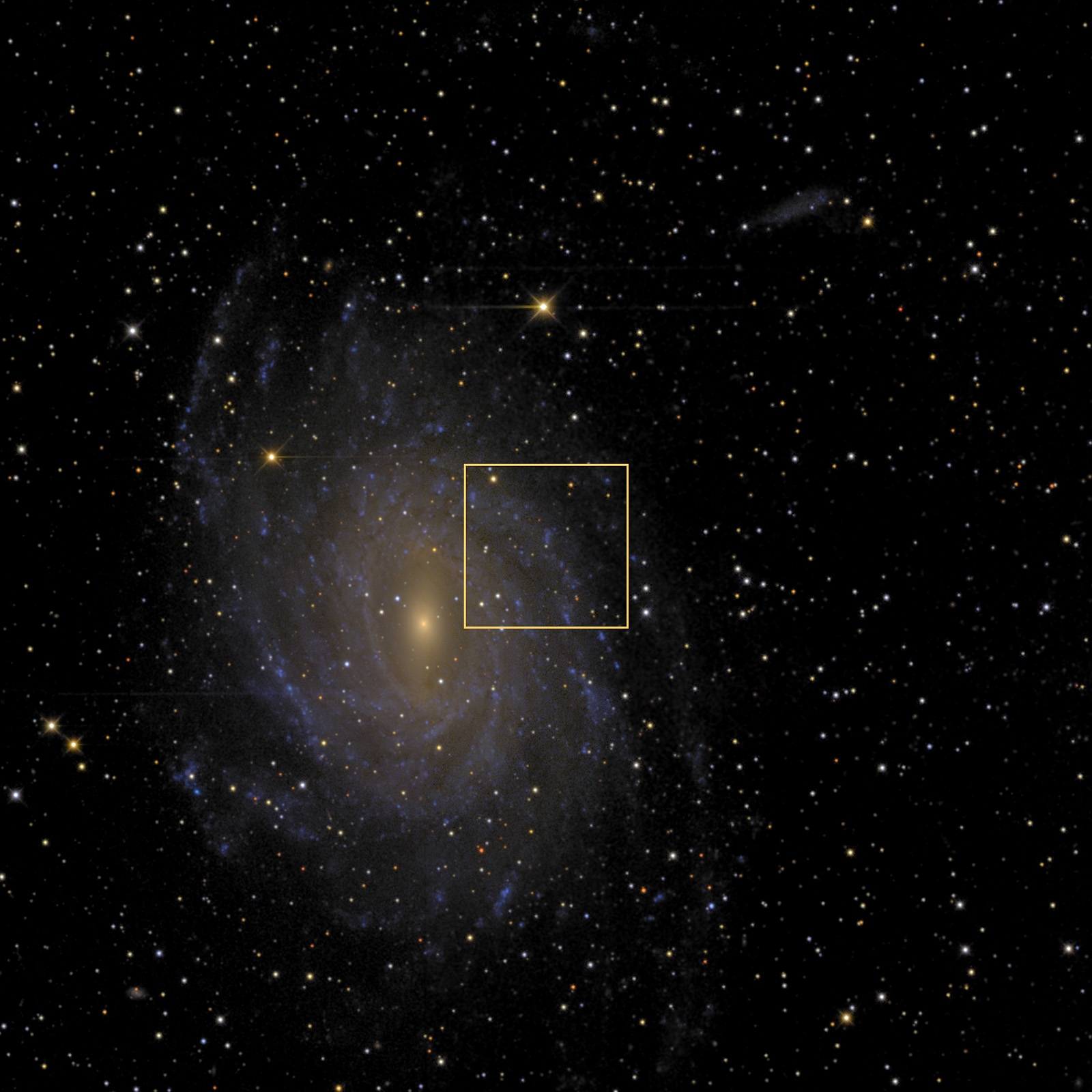
(l-r) Close-ups of the explosion site before the explosion, after it, and with the other celestial objects subtracted.

A clue to the mystery emerged by chance when the scientists noticed that images released by the Euclid space telescope included an earlier view of the same galaxy, taken 11 months before the explosion. To pinpoint the exact pixel in the earlier image where they should look for the doomed star, they combined data from hundreds of images of the explosion captured by BlackGEM.

“Unfortunately, we couldn’t find a star there,” Zimmerman says. “So we calculated how bright the star could have been without showing up in the telescope images. This revealed to us that, unlike other supernovae we’ve observed, this explosion did not involve a bright star. Instead, it may have originated in a system consisting of a white dwarf and a faint companion star, or perhaps a pair of white dwarfs.”

To better understand the explosion, the scientists monitored it for almost a year, repeatedly measuring its spectrum and brightness. “Because the explosion was so faint, we expected it to fade and disappear quickly, as predicted by a physical principle more than 30 years old known as the Phillips relation,” Zimmerman says. “Instead, the faint supernova continued to shine for a remarkably long time.”

An ordinary supernova driven by nuclear fusion continues to shine brightly for about a month to a month and a half, long after the energy of the initial explosion has dissipated. This is possible thanks to a radioactive “battery”: radioactive nickel produced during the explosion, which subsequently decays, releasing high-energy radiation. This radiation heats the dense cloud of gas, causing it to glow. But as the cloud expands, it eventually becomes thin enough for the radiation to “escape,” and the supernova fades.

“We discovered that the slow fading was the result of an explosion too weak to disperse the gas cloud efficiently,” Zimmerman explains. “The cloud only became thin enough for radiation to escape after more than 70 days. The radioactive material was also moving very slowly, and this combination of conditions kept high-energy radiation trapped inside the cloud, continuing to heat the gas and allowing the supernova to keep glowing.”

"In the coming decade, we’ll be able to detect fainter and more distant supernovae than ever before, opening up many opportunities to investigate how these explosions arise and how they shape the universe.”
The discovery was made possible by two computational methods, one of which is the “Katz integral,” developed in the 2010s at the Weizmann Institute of Science by Prof. Boaz Katz. Close collaboration between experimental and theoretical researchers at the Institute allowed the scientists to consult the method’s developer in real time as they collected and analyzed their measurements.

“We live in an exciting era in which both ground-based sky surveys and space telescopes are becoming increasingly sophisticated,” says Gal-Yam. “Our new study provides a roadmap for observations that will harness new technologies to uncover the secrets of exploding stars. Studying supernovae teaches us physicists not only about the final chapter in a star’s life, but also about the evolution of galaxies, the expansion of the universe and the origins of the chemical elements we know. In the coming decade, we’ll be able to detect fainter and more distant supernovae than ever before, opening up many opportunities to investigate how these explosions arise and how they shape the universe.”

Slow Burn 3
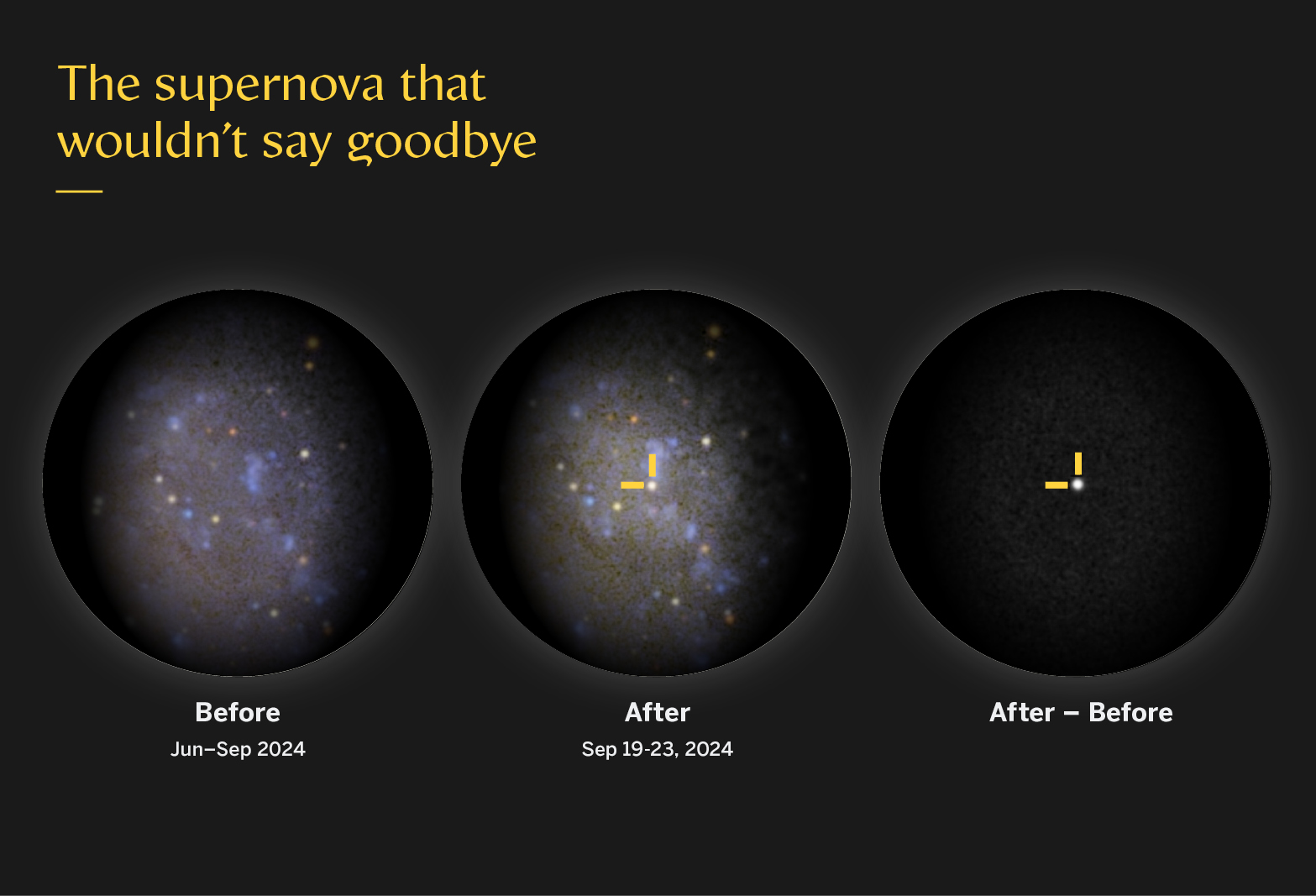
Image of the NGC 6744 galaxy, taken by the BlackGEM optical telescope array in Chile’s Atacama Desert after the explosion of the faintest supernova ever observed.

Also participating in the study were Prof. Eran Ofek, Dr. Steve Schulze, Dr. Tamar Faran, Avshalom Badash and Dr. Ofer Yaron of Weizmann’s Particle Physics and Astrophysics Department; Dr. Jan van Roestel of the University of Amsterdam, the Netherlands; Dr. Andrea Pastorello, Dr. Andrea Reguitti and Giorgio Valerin of the INAF Astronomical Observatory of Padova, Italy; Emily Hoang, Nicolás Meza Retamal, Darshana Mehta, Prof. Stefano Valenti and Dr. Aravind Ravi of the University of California, Davis; Prof. Ping Chen of Zhejiang University, China; Prof. Nadejda Blagorodnova, Dr. Maxime Wavasseur, Dr. Marco Gómez-Muñoz and Dr. Hugo Tranin of the University of Barcelona, Spain; Dr. Simon de Wet and Dr. Giorgos Leloudas of the Technical University of Denmark in Kongens Lyngby; Dr. Paul Vreeswijk, Dr. Steven Bloemen and Daniëlle Pieterse of Radboud University in Nijmegen, the Netherlands; Dr. Lindsey Kwok of the Center for Interdisciplinary Exploration and Research in Astrophysics (CIERA) in Evanston, Illinois; Michaela Schwab and Prof. Saurabh Jha of Rutgers University in Piscataway, New Jersey; Prof. Kate Maguire of the University of Dublin, Ireland; Prof. David Sand, Dr. K. Azalee Bostroem, Dr. Jeniveve Pearson and Dr. Bhagya Subrayan of the University of Arizona; Eric Stringer and Prof. Thomas Kupfer of the University of Hamburg, Germany; Dr. Joseph Anderson and Rita Santos of the European Southern Observatory in Santiago, Chile; Dr. Jennifer Andrews of the Gemini Observatory in Hilo, Hawaii; Moira Andrews, Dr. Joseph Farah, Dr. Andrew Howell, Dr. Yuan Qi Ni, Dr. Curtis McCully and Kathryn Wynn of Las Cumbres Observatory in Goleta, California; Prof. Ting-Wan Chen of National Central University in Jhongli, Taiwan; Dr. Massimo Della Valle of the Astronomical Observatory of Capodimonte in Naples, Italy; Dr. Georgios Dimitriadis and Dr. Andrew Milligan of Lancaster University, UK; Dr. Yize Dong of the Center for Astrophysics, Harvard & Smithsonian in Cambridge, Massachusetts; Dr. Nicolas Erasmus and Orapeleng Mogawana of the South African Astronomical Observatory; Dr. James Gillanders, Dr. Shubham Srivastav and Dr. Fiorenzo Stoppa of the University of Oxford, UK; Benjamin Godson, Prof. Joseph Lyman and Dr. Mark Magee of the University of Warwick in Coventry, UK; Prof. Mariusz Gromadzki of the University of Warsaw, Poland; Prof. Daichi Hiramatsu of the University of Florida in Gainesville; Prof. Daryl Janzen of the University of Saskatchewan in Saskatoon, Canada; Prof. Hanindyo Kuncarayakti of the University of Turku, Finland; Dr. Jiaxuan Li of Princeton University in New Jersey; Prof. Keiichi Maeda of Kyoto University, Japan; Shane Moran of the University of Leicester, UK; Dr. David O’Neill of the University of Birmingham, UK; Prof. Giuliano Pignata of the University of Tarapacá in Arica, Chile; Daniel Reichart of the University of North Carolina at Chapel Hill; Prof. Simone Scaringi of Durham University, UK; Dr. Manisha Shrestha of Monash University in Melbourne, Australia; Prof. Xiaofeng Wang of Tsinghua University in Beijing, China; and Prof. Weicheng Zang of Westlake University in Hangzhou, China.

Prof. Avishay Gal-Yam's research is supported by the Norman E. Alexander Family M Foundation ULTRASAT Data Center Fund and by Magnus Konow in honor of his mother Olga Konow Rappaport.

Prof. Gal-Yam is the incumbent of the Arlyn Imberman Professorial Chair.

Exploring the Physical World

Slow Burn: The Faintest Supernova Ever Observed Refused to Fade 

An international team led by the Weizmann Institute of Science has discovered  that spectacular supernovae don’t always have a bright star behind them 

TAGS: Astrophysics , Collaborations , Physics , Space , Technology

Slow Burn 1
(l-r) Prof. Eran Ofek, Prof. Avishay Gal-Yam and Erez Zimmerman

REHOVOT, ISRAEL — November 26, 2026 — For the first few weeks after a star explodes in a supernova, it can shine as brightly as an entire galaxy of billions of stars. It’s tempting to assume that every spectacular supernova involves a brilliant star, but an international team of scientists who tracked the faintest supernova ever observed has shown that even dim stars can put on a dazzling finale. The findings of the new study, led by Prof. Avishay Gal-Yam’s group at the Weizmann Institute of Science and published today in Nature Astronomy, suggest that the relatively feeble explosion was the work of a binary system of small, dim stars. Faint supernovae are known to fade quickly, yet supernova SN 2024vjm faded slowly. The researchers have now revealed why, challenging an astrophysical principle that has stood firm for more than 30 years.

The best-known space telescopes, Hubble and James Webb, look at the universe as if through a drinking straw – they can see extremely far, but only a tiny sliver of the sky at any given moment. But catching a star in the act of exploding requires panoramic images: Such explosions occur only about once a century in a galaxy like our own, so astronomers must scan vast stretches of sky to spot them in distant galaxies. That, among other things, is what sky surveys are designed to provide. One of the most advanced, BlackGEM, which began operating in 2023 in Chile’s Atacama Desert, scans the southern sky. An international team has formed around it to study changes and transient phenomena.

“One autumn night two years ago, a minute before midnight GMT, BlackGEM recorded a new spot of light in the night sky,” says doctoral student Erez Zimmerman of Gal-Yam’s group, who led the new study. “When Prof. Paul Groot of Radboud University in the Netherlands reviewed the images the next morning, he spotted it and quickly alerted the international team through their group chat. The sudden appearance of a bright spot of light 30 million light-years away made us suspect it was a supernova, but it looked fainter than any supernova we had ever seen. Since a supernova is a transient event that reaches peak brightness within days to weeks, researchers around the world mobilized to quickly gather as much information about it as possible.”

The first measurement astrophysicists make when trying to understand a new phenomenon in the sky is of the spectrum of light reaching us from it. This reveals, among other things, which materials are present and how fast they are moving. “The results astounded us,” Zimmerman says. “In ordinary supernovae, the powerful explosion hurls into space a cloud of gas that expands at about 10,000 kilometers per second – but here the cloud was moving at only 3,000 kilometers per second. For a moment, we wondered whether we were witnessing some other kind of cosmic event.” Yet the composition of the material confirmed that this was indeed a supernova driven by nuclear fusion – much like a hydrogen bomb. So what kind of star had ended its life with such a whimper?

Slow Burn 2
(l-r) Close-ups of the explosion site before the explosion, after it, and with the other celestial objects subtracted.

A clue to the mystery emerged by chance when the scientists noticed that images released by the Euclid space telescope included an earlier view of the same galaxy, taken 11 months before the explosion. To pinpoint the exact pixel in the earlier image where they should look for the doomed star, they combined data from hundreds of images of the explosion captured by BlackGEM.

“Unfortunately, we couldn’t find a star there,” Zimmerman says. “So we calculated how bright the star could have been without showing up in the telescope images. This revealed to us that, unlike other supernovae we’ve observed, this explosion did not involve a bright star. Instead, it may have originated in a system consisting of a white dwarf and a faint companion star, or perhaps a pair of white dwarfs.”

To better understand the explosion, the scientists monitored it for almost a year, repeatedly measuring its spectrum and brightness. “Because the explosion was so faint, we expected it to fade and disappear quickly, as predicted by a physical principle more than 30 years old known as the Phillips relation,” Zimmerman says. “Instead, the faint supernova continued to shine for a remarkably long time.”

An ordinary supernova driven by nuclear fusion continues to shine brightly for about a month to a month and a half, long after the energy of the initial explosion has dissipated. This is possible thanks to a radioactive “battery”: radioactive nickel produced during the explosion, which subsequently decays, releasing high-energy radiation. This radiation heats the dense cloud of gas, causing it to glow. But as the cloud expands, it eventually becomes thin enough for the radiation to “escape,” and the supernova fades.

“We discovered that the slow fading was the result of an explosion too weak to disperse the gas cloud efficiently,” Zimmerman explains. “The cloud only became thin enough for radiation to escape after more than 70 days. The radioactive material was also moving very slowly, and this combination of conditions kept high-energy radiation trapped inside the cloud, continuing to heat the gas and allowing the supernova to keep glowing.”

"In the coming decade, we’ll be able to detect fainter and more distant supernovae than ever before, opening up many opportunities to investigate how these explosions arise and how they shape the universe.”

The discovery was made possible by two computational methods, one of which is the “Katz integral,” developed in the 2010s at the Weizmann Institute of Science by Prof. Boaz Katz. Close collaboration between experimental and theoretical researchers at the Institute allowed the scientists to consult the method’s developer in real time as they collected and analyzed their measurements.

“We live in an exciting era in which both ground-based sky surveys and space telescopes are becoming increasingly sophisticated,” says Gal-Yam. “Our new study provides a roadmap for observations that will harness new technologies to uncover the secrets of exploding stars. Studying supernovae teaches us physicists not only about the final chapter in a star’s life, but also about the evolution of galaxies, the expansion of the universe and the origins of the chemical elements we know. In the coming decade, we’ll be able to detect fainter and more distant supernovae than ever before, opening up many opportunities to investigate how these explosions arise and how they shape the universe.”

Slow Burn 3
Image of the NGC 6744 galaxy, taken by the BlackGEM optical telescope array in Chile’s Atacama Desert after the explosion of the faintest supernova ever observed.

Also participating in the study were Prof. Eran Ofek, Dr. Steve Schulze, Dr. Tamar Faran, Avshalom Badash and Dr. Ofer Yaron of Weizmann’s Particle Physics and Astrophysics Department; Dr. Jan van Roestel of the University of Amsterdam, the Netherlands; Dr. Andrea Pastorello, Dr. Andrea Reguitti and Giorgio Valerin of the INAF Astronomical Observatory of Padova, Italy; Emily Hoang, Nicolás Meza Retamal, Darshana Mehta, Prof. Stefano Valenti and Dr. Aravind Ravi of the University of California, Davis; Prof. Ping Chen of Zhejiang University, China; Prof. Nadejda Blagorodnova, Dr. Maxime Wavasseur, Dr. Marco Gómez-Muñoz and Dr. Hugo Tranin of the University of Barcelona, Spain; Dr. Simon de Wet and Dr. Giorgos Leloudas of the Technical University of Denmark in Kongens Lyngby; Dr. Paul Vreeswijk, Dr. Steven Bloemen and Daniëlle Pieterse of Radboud University in Nijmegen, the Netherlands; Dr. Lindsey Kwok of the Center for Interdisciplinary Exploration and Research in Astrophysics (CIERA) in Evanston, Illinois; Michaela Schwab and Prof. Saurabh Jha of Rutgers University in Piscataway, New Jersey; Prof. Kate Maguire of the University of Dublin, Ireland; Prof. David Sand, Dr. K. Azalee Bostroem, Dr. Jeniveve Pearson and Dr. Bhagya Subrayan of the University of Arizona; Eric Stringer and Prof. Thomas Kupfer of the University of Hamburg, Germany; Dr. Joseph Anderson and Rita Santos of the European Southern Observatory in Santiago, Chile; Dr. Jennifer Andrews of the Gemini Observatory in Hilo, Hawaii; Moira Andrews, Dr. Joseph Farah, Dr. Andrew Howell, Dr. Yuan Qi Ni, Dr. Curtis McCully and Kathryn Wynn of Las Cumbres Observatory in Goleta, California; Prof. Ting-Wan Chen of National Central University in Jhongli, Taiwan; Dr. Massimo Della Valle of the Astronomical Observatory of Capodimonte in Naples, Italy; Dr. Georgios Dimitriadis and Dr. Andrew Milligan of Lancaster University, UK; Dr. Yize Dong of the Center for Astrophysics, Harvard & Smithsonian in Cambridge, Massachusetts; Dr. Nicolas Erasmus and Orapeleng Mogawana of the South African Astronomical Observatory; Dr. James Gillanders, Dr. Shubham Srivastav and Dr. Fiorenzo Stoppa of the University of Oxford, UK; Benjamin Godson, Prof. Joseph Lyman and Dr. Mark Magee of the University of Warwick in Coventry, UK; Prof. Mariusz Gromadzki of the University of Warsaw, Poland; Prof. Daichi Hiramatsu of the University of Florida in Gainesville; Prof. Daryl Janzen of the University of Saskatchewan in Saskatoon, Canada; Prof. Hanindyo Kuncarayakti of the University of Turku, Finland; Dr. Jiaxuan Li of Princeton University in New Jersey; Prof. Keiichi Maeda of Kyoto University, Japan; Shane Moran of the University of Leicester, UK; Dr. David O’Neill of the University of Birmingham, UK; Prof. Giuliano Pignata of the University of Tarapacá in Arica, Chile; Daniel Reichart of the University of North Carolina at Chapel Hill; Prof. Simone Scaringi of Durham University, UK; Dr. Manisha Shrestha of Monash University in Melbourne, Australia; Prof. Xiaofeng Wang of Tsinghua University in Beijing, China; and Prof. Weicheng Zang of Westlake University in Hangzhou, China.

Prof. Avishay Gal-Yam's research is supported by the Norman E. Alexander Family M Foundation ULTRASAT Data Center Fund and by Magnus Konow in honor of his mother Olga Konow Rappaport.

Prof. Gal-Yam is the incumbent of the Arlyn Imberman Professorial Chair.