
Improving Health & Medicine

Knock, Knock! Who’s There?

When blind mole rats bang their heads against tunnel walls, they send surprisingly personalized messages – directed toward particular intruders and adjusted depending on who’s approaching, Weizmann Institute and Tel Aviv University researchers reveal

Knock Knock Who’S There 1
(l-r) Prof. Tali Kimchi and Prof. Yossi Yovel

REHOVOT, ISRAEL — November 25, 2026 — Just below ground lives a hardy, aggressive and happy-enough animal that positively thrives on extreme social isolation. The blind mole rat – which, as its name suggests, is sightless – digs its own tunnel system, where it then lives entirely alone, fiercely guarding its turf and drumming its head against the tunnel walls to produce vibrations in the ground. In a new study published today in Current Biology, researchers from the Weizmann Institute of Science and Tel Aviv University have shown that these vibrations do not spread uniformly in all directions but are directed toward a potential intruder. When the intruder is of the opposite sex, the head-drumming intensifies. The researchers also found that each blind mole rat has its own signature beat.

In their underground world, where sight is of little use and airborne communication is limited, soil vibrations provide blind mole rats with a way to get a message across. Other animals, too – from tiny planthoppers that send messages along plant stems by shaking their abdomens, to elephants whose deep rumbles travel through the ground – have long been known to communicate using vibrations. But how much information can such vibrations carry? And can they be targeted at a specific recipient – making them more like a conversation with a particular neighbor than a general announcement?

The research team, headed by Prof. Tali Kimchi of Weizmann’s Brain Sciences Department and Prof. Yossi Yovel of Tel Aviv University’s School of Zoology, set out to answer these questions by building a special outdoor installation that mimicked the animals’ natural underground habitat. At its center was a mesh cage buried below ground, allowing a blind mole rat to dig its own burrows at their usual depth. More than 30 sensitive recorders were arranged around the cage to capture the vibrations traveling through the soil.

Another blind mole rat was then introduced into the setup, where the two animals could sense each other’s presence without making physical contact. In nature, coming into such contact uninvited is not recommended: If one blind mole rat enters a burrow inhabited by another, the result is usually a fight to the death – for the resident, the intruder or both.

The recordings revealed that the vibrations generated by the resident’s head-drumming were strongest in the direction of the approaching intruder. When the intruder approached from the opposite side, the direction of the signals changed accordingly. The researchers believe that the blind mole rats achieve this by adjusting the position of their heads and the angle at which they strike the tunnel wall, but exactly how they control the direction of their signals remains to be established.

The identity of the visitor also mattered – or at least its sex. When the intruder was of the same sex, the resident produced an average of about 3.5 bursts of head-drumming per minute. But when a member of the opposite sex approached, the rate nearly doubled, to about 6.5 bursts per minute. The increased drumming suggests that the signals serve more than one purpose: They may help defend territory, but they could also play a role in welcoming a prospective partner.

And just as every human drummer has a style of their own, blind mole rats seem to have their own signature beats. Using artificial intelligence, the researchers analyzed the timing, rhythm and shape of thousands of individual head drums. The algorithm was able to distinguish between different mole rats, even when the animals had switched roles from resident to intruder.

“Even an animal that spends most of its life alone, in darkness beneath the ground, needs to communicate with members of its own species,” Yovel says. “We still don’t know whether blind mole rats use their distinctive head-drumming patterns to recognize one another, but our findings reveal a level of sophistication in their underground communication that we hadn’t appreciated before.”

“The findings open a unique window into the biological mechanisms behind solitary behavior and communication through ground vibrations,” Kimchi says. “They may help us understand both the brain circuits involved in the animals’ response to intruders and the sensory pathways that allow them to interpret these signals – including, apparently, distinguishing between male and female visitors.”

The study was led by Ragad Hamade and George Atmeh of the Kimchi lab; Dr. Noam Goder of the Yovel lab; and Dr. Grace Smarsh, a joint postdoctoral fellow of Kimchi and Yovel. Also taking part in the research were Gal Frydman of the Yovel lab; Profs. Ariel Lellouch and Moshe Reshef of Tel Aviv University’s Department of Geophysics; and Dr. Noga Zilkha of the Kimchi lab.

Knock Knock Who’S There 2
Ragad Hamade

Of love and darkness

In earlier work, Kimchi’s team, in collaboration with Yovel’s lab, had helped establish the blind mole rat as a model for studying the brain mechanisms underlying sociability – or the lack thereof. While scientists have traditionally relied in such studies on the contact-craving mice and rats, which seem to get on famously with their companions, blind mole rats offer a glimpse of the opposite end of the sociability spectrum. In fact, the only time they seek companionship is during their breeding season.

"Such findings may eventually offer broader insights into the neural foundations of social behavior in the mammalian brain, including aspects relevant to human conditions involving difficulties with social interaction."

The Kimchi lab has been investigating how the animals’ brains process social signals and what allows them to switch between aggression and reproductive encounters. Their studies have already revealed differences between the brains of blind mole rats and those of more sociably adept rodents, including differences in cells that secrete oxytocin, a hormone involved in social bonding and reproduction.

By combining studies of blind mole rats’ behavior with investigations of their brain, the researchers hope to identify the mechanisms that govern social avoidance, aggression and the rare moments when these solitary animals seek one another out. Such findings may eventually offer broader insights into the neural foundations of social behavior in the mammalian brain, including aspects relevant to human conditions involving difficulties with social interaction.
Knock Knock Who’S There 3
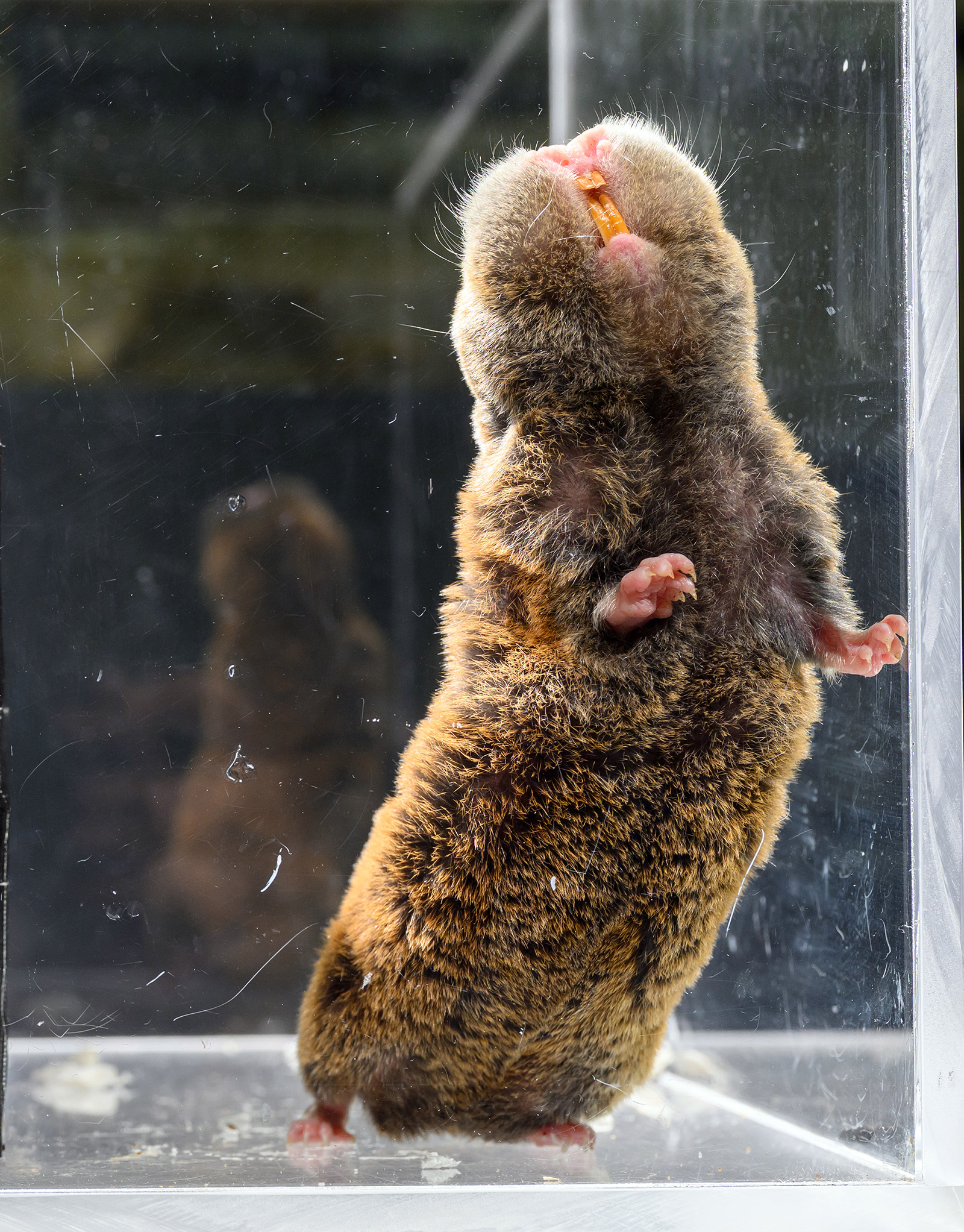
When loners reach out. A blind mole rat in action.

Prof. Tali Kimchi’s research is supported by the David and Fela Shapell Family Center for Genetic Disorders Research; the Ilse Katz Institute for Material Sciences and Magnetic Resonance Research; the Sagol Institute for Longevity Research; the Irene and Jared M. Drescher Center for Research on Mental and Emotional Health; and the Mike and Valeria Rosenbloom Center for Research on Positive Neuroscience.


Improving Health & Medicine

Knock, Knock! Who’s There?

When blind mole rats bang their heads against tunnel walls, they send surprisingly personalized messages – directed toward particular intruders and adjusted depending on who’s approaching, Weizmann Institute and Tel Aviv University researchers reveal

TAGS: Artificial intelligence , Biology , Behavior , Brain , Collaborations , Nature , Neuroscience , Senses

Knock Knock Who’S There 1
(l-r) Prof. Tali Kimchi and Prof. Yossi Yovel

REHOVOT, ISRAEL — November 25, 2026 — Just below ground lives a hardy, aggressive and happy-enough animal that positively thrives on extreme social isolation. The blind mole rat – which, as its name suggests, is sightless – digs its own tunnel system, where it then lives entirely alone, fiercely guarding its turf and drumming its head against the tunnel walls to produce vibrations in the ground. In a new study published today in Current Biology, researchers from the Weizmann Institute of Science and Tel Aviv University have shown that these vibrations do not spread uniformly in all directions but are directed toward a potential intruder. When the intruder is of the opposite sex, the head-drumming intensifies. The researchers also found that each blind mole rat has its own signature beat.

In their underground world, where sight is of little use and airborne communication is limited, soil vibrations provide blind mole rats with a way to get a message across. Other animals, too – from tiny planthoppers that send messages along plant stems by shaking their abdomens, to elephants whose deep rumbles travel through the ground – have long been known to communicate using vibrations. But how much information can such vibrations carry? And can they be targeted at a specific recipient – making them more like a conversation with a particular neighbor than a general announcement?

The research team, headed by Prof. Tali Kimchi of Weizmann’s Brain Sciences Department and Prof. Yossi Yovel of Tel Aviv University’s School of Zoology, set out to answer these questions by building a special outdoor installation that mimicked the animals’ natural underground habitat. At its center was a mesh cage buried below ground, allowing a blind mole rat to dig its own burrows at their usual depth. More than 30 sensitive recorders were arranged around the cage to capture the vibrations traveling through the soil.

Another blind mole rat was then introduced into the setup, where the two animals could sense each other’s presence without making physical contact. In nature, coming into such contact uninvited is not recommended: If one blind mole rat enters a burrow inhabited by another, the result is usually a fight to the death – for the resident, the intruder or both.

The recordings revealed that the vibrations generated by the resident’s head-drumming were strongest in the direction of the approaching intruder. When the intruder approached from the opposite side, the direction of the signals changed accordingly. The researchers believe that the blind mole rats achieve this by adjusting the position of their heads and the angle at which they strike the tunnel wall, but exactly how they control the direction of their signals remains to be established.

The identity of the visitor also mattered – or at least its sex. When the intruder was of the same sex, the resident produced an average of about 3.5 bursts of head-drumming per minute. But when a member of the opposite sex approached, the rate nearly doubled, to about 6.5 bursts per minute. The increased drumming suggests that the signals serve more than one purpose: They may help defend territory, but they could also play a role in welcoming a prospective partner.

And just as every human drummer has a style of their own, blind mole rats seem to have their own signature beats. Using artificial intelligence, the researchers analyzed the timing, rhythm and shape of thousands of individual head drums. The algorithm was able to distinguish between different mole rats, even when the animals had switched roles from resident to intruder.

“Even an animal that spends most of its life alone, in darkness beneath the ground, needs to communicate with members of its own species,” Yovel says. “We still don’t know whether blind mole rats use their distinctive head-drumming patterns to recognize one another, but our findings reveal a level of sophistication in their underground communication that we hadn’t appreciated before.”

“The findings open a unique window into the biological mechanisms behind solitary behavior and communication through ground vibrations,” Kimchi says. “They may help us understand both the brain circuits involved in the animals’ response to intruders and the sensory pathways that allow them to interpret these signals – including, apparently, distinguishing between male and female visitors.”

The study was led by Ragad Hamade and George Atmeh of the Kimchi lab; Dr. Noam Goder of the Yovel lab; and Dr. Grace Smarsh, a joint postdoctoral fellow of Kimchi and Yovel. Also taking part in the research were Gal Frydman of the Yovel lab; Profs. Ariel Lellouch and Moshe Reshef of Tel Aviv University’s Department of Geophysics; and Dr. Noga Zilkha of the Kimchi lab.

Knock Knock Who’S There 2
Ragad Hamade

Of love and darkness

In earlier work, Kimchi’s team, in collaboration with Yovel’s lab, had helped establish the blind mole rat as a model for studying the brain mechanisms underlying sociability – or the lack thereof. While scientists have traditionally relied in such studies on the contact-craving mice and rats, which seem to get on famously with their companions, blind mole rats offer a glimpse of the opposite end of the sociability spectrum. In fact, the only time they seek companionship is during their breeding season.

"Such findings may eventually offer broader insights into the neural foundations of social behavior in the mammalian brain, including aspects relevant to human conditions involving difficulties with social interaction."

The Kimchi lab has been investigating how the animals’ brains process social signals and what allows them to switch between aggression and reproductive encounters. Their studies have already revealed differences between the brains of blind mole rats and those of more sociably adept rodents, including differences in cells that secrete oxytocin, a hormone involved in social bonding and reproduction.

By combining studies of blind mole rats’ behavior with investigations of their brain, the researchers hope to identify the mechanisms that govern social avoidance, aggression and the rare moments when these solitary animals seek one another out. Such findings may eventually offer broader insights into the neural foundations of social behavior in the mammalian brain, including aspects relevant to human conditions involving difficulties with social interaction.

Knock Knock Who’S There 3
When loners reach out. A blind mole rat in action.

Prof. Tali Kimchi’s research is supported by the David and Fela Shapell Family Center for Genetic Disorders Research; the Ilse Katz Institute for Material Sciences and Magnetic Resonance Research; the Sagol Institute for Longevity Research; the Irene and Jared M. Drescher Center for Research on Mental and Emotional Health; and the Mike and Valeria Rosenbloom Center for Research on Positive Neuroscience.