
Exploring the Physical World

DNA Teaches Matter Some New Moves

In two pioneering studies, Weizmann Institute scientists use DNA to control and synchronize motion driven by molecular motors, opening a route to genetically programmed biomaterials

DNA Teaches Matter Some New Moves 1
Participants in the Nature Materials study. From left: standing, Rochelle Silverman and Dr. Hillel Aharoni; seated, Dr. Alexandra Tayar, and Dr. Erez Zerbib

REHOVOT, ISRAEL — November 9, 2026 — Biological systems constantly generate motion and flow. Think of the corkscrew swimming of bacteria, sperm cells beating their flagella on their way to the egg or the ceaseless movement of molecules and organelles inside cells. Behind many of these phenomena lies “active matter”: materials whose components act as tiny molecular motors, consuming chemical energy and converting it into mechanical work. Now, researchers in Dr. Alexandra Tayar’s lab at the Weizmann Institute of Science have created two new kinds of artificial active matter: one performs tasks and changes shape according to a genetic code; the other shapes its own motion through the self-organization of DNA strands. These two breakthroughs, published in Nature Materials and Nature Physics, lay the groundwork for developing new, genetically programmed materials for a variety of applications, from soft robots to targeted therapies.
DNA Teaches Matter Some New Moves 2
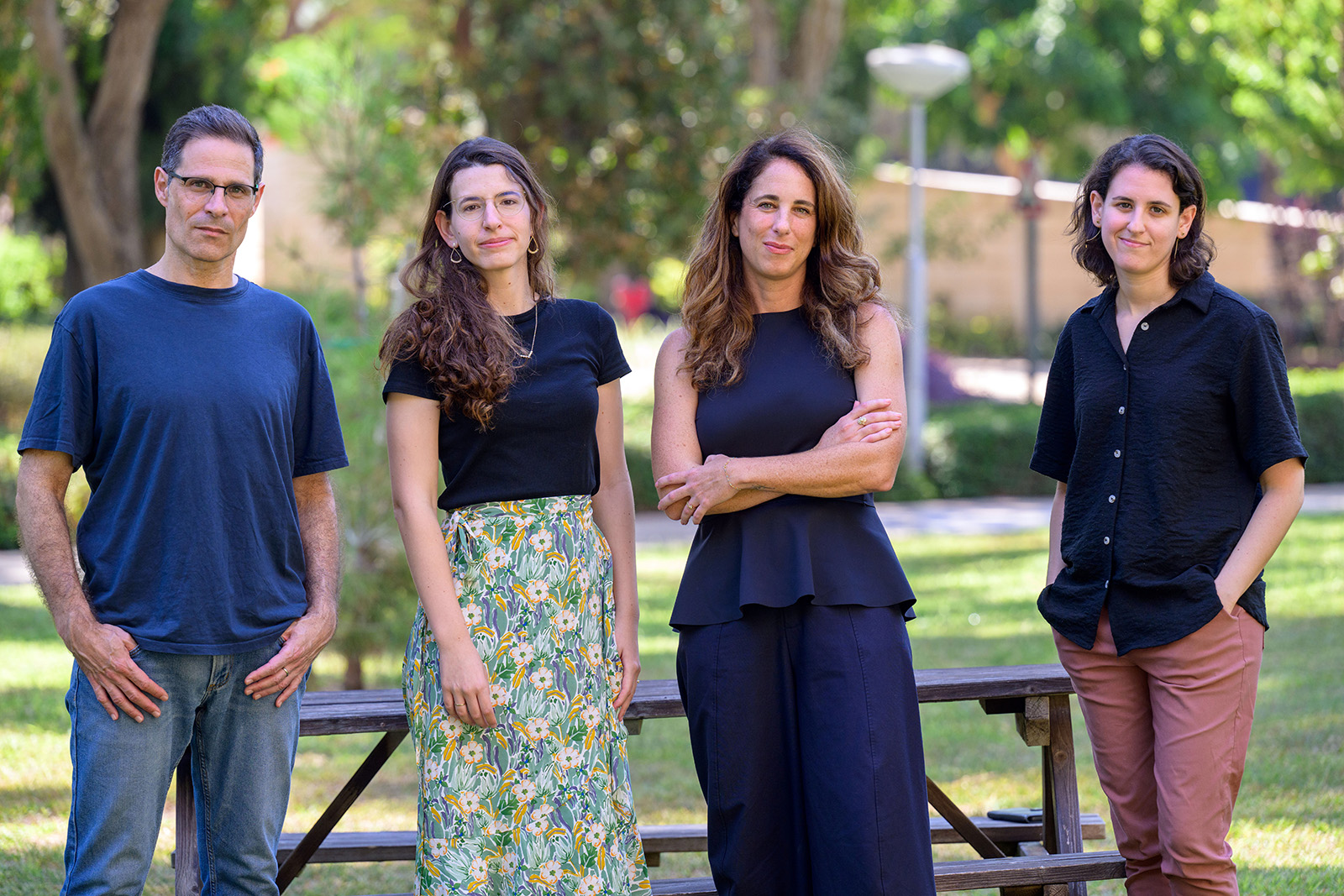
The Nature Physics research team. From left: Prof. Eran Bouchbinder, Noa Goldberg, Dr. Alexandra Tayar, and Maya Levanon

Unlike ordinary materials, active matter takes its fate into its own hands: It burns chemical fuel, moves, and performs mechanical work, shaping its own properties. Only in the past two decades have scientists begun to understand the physical principles that govern the organization of active matter and how these principles might be harnessed to perform tasks on demand.

To develop new kinds of active matter, they borrow building blocks from living cells, such as the network of tiny tubes called microtubules that forms part of the cell’s cytoskeleton, along which motor proteins transport molecular cargo. But scientists’ ability to control active matter has to date remained limited mainly to altering its composition – for example, the type and quantity of microtubules and motor proteins. A major challenge has remained: enabling the material itself to sense its own state and adjust its activity accordingly.

When Tayar established her lab in Weizmann’s Chemical and Biological Physics Department about four years ago, she decided to combine her two areas of expertise: active matter powered by molecular motors and artificial systems enabling gene expression outside cells. This combination gave rise to the question that drove the first study: Could artificial matter be equipped with a genetic program allowing it to produce molecular motors governing its own activity?

“I hope that combining these different tools will eventually enable us to develop smarter materials for a wide range of applications.”
DNA Teaches Matter Some New Moves 3
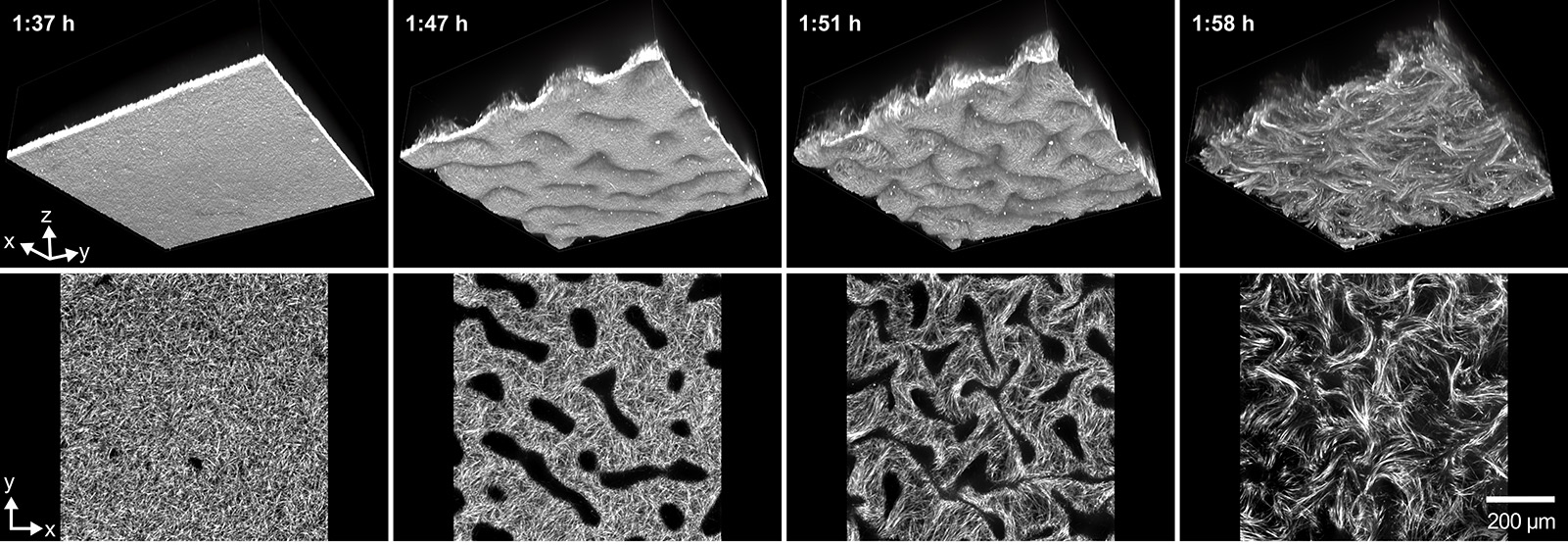
DNA calls the shots: A confocal microscope view of an active material containing DNA that encodes molecular motors. Initially, the material formed a stationary network of microtubules (left column). Once the force exerted by the motors overcame the network’s elasticity, the microtubules began to move and organize into increasingly large protrusions (two middle columns). Eventually, the network broke into bundles of microtubules that swirled in small vortices for hours (right column)

In the study, led by doctoral student Rochelle Silverman and staff scientist Dr. Erez Zerbib of Tayar’s lab, in collaboration with Prof. Vincent Noireaux of the University of Minnesota, the researchers embedded DNA and a gene expression system within a network of microtubules. This enabled the material to produce its own molecular motors according to the information encoded in the DNA. 

First, the researchers introduced a gene encoding a motor protein and arranged for it to be expressed continuously, so that the concentration of motors in the material steadily increased. Once motor activity crossed the threshold needed to overcome the elastic forces that held the network in place, the material “came to life”: The microtubules began to move and organize into protrusions that grew progressively larger. Eventually, the network broke into bundles of microtubules that swirled in small vortices for hours.

Confocal microscopy videos showing 3D and 2D views of an active material containing DNA that encodes molecular motors. Initially, the material formed a stationary network of microtubules. As the force exerted by the motors overcame the network’s elasticity, the microtubules began to move, forming increasingly large protrusions. Eventually, the network broke into bundles of microtubules that swirled in small vortices for hours

To control the rate at which the motors accumulated, the researchers varied the concentration of the introduced gene from one experiment to the next. This allowed them to determine when the material would begin moving, how fast it would move and how quickly it would transition between different mechanical states. Genetic control, however, did not determine where protrusions would form or how they would spread. To gain control over these properties, the researchers used 3D printers to create microscopic channels and ridges in the active material’s surroundings. This allowed them to determine the location and dimensions of the protrusions, demonstrating that geometric constraints could provide an additional, programmable layer of control.
DNA Teaches Matter Some New Moves 4
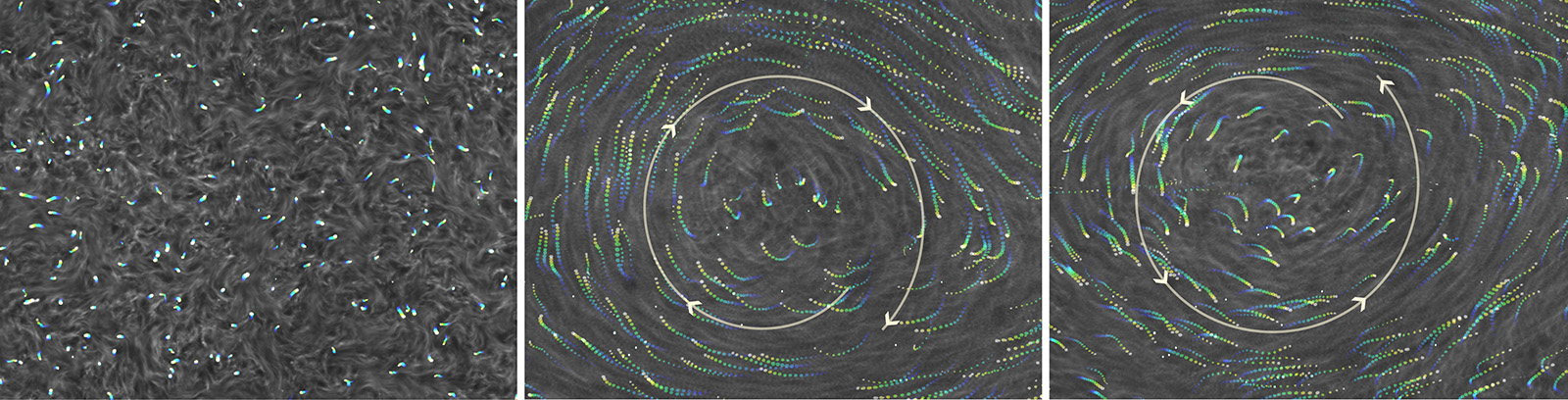
Choreography of matter: To track the movement of an active material containing long DNA molecules, the researchers used fluorescent tracer particles. Initially, the flow consisted of small, localized, randomly moving vortices (left). After about an hour, the material’s motion became oscillatory and synchronized, switching every few minutes between clockwise (center) and counterclockwise (right) rotation

Having developed an active material with an “open-source” genetic program, the researchers went on to demonstrate how this genetic control could be put to work.

“We programmed the material to move briefly and then come to a stop,” Silverman explains. “To do this, we introduced a gene encoding a bridging protein, a kind of molecular Velcro that connects neighboring tubes. Bringing the tubes closer together initially helped the motor proteins to grip them, set them in motion and change the material’s shape. At the same time, however, friction developed between the tubes, quickly bringing the movement to a halt. Next, we programmed the material to undergo bursts of movement at regular intervals by introducing another protein that shuts down production of the motor protein after a certain time. In this system, we made sure that all the proteins would be rapidly degraded to make way for the next pulse.”

“We turned familiar biological variables, such as the rate of gene expression or a genetic feedback loop, into physical variables that can be used to predict and design the properties of artificial materials,” Tayar elaborates. “Thanks to our collaboration with Dr. Hillel Aharoni of Weizmann’s Physics of Complex Systems Department, we also developed a simple theoretical model that successfully explained how changes in gene expression translate into changes in the material’s structure. This scientific foundation could eventually make it possible to design active materials equipped with a genetic code that enables them to change their own structure and function on demand.”

From tiny motors to large-scale motion

Although the first study provided new ways to control active matter, it left a fundamental mystery unresolved: How do countless microscopic interactions among tiny motors give rise to large-scale, coordinated motion?

The first clue emerged during Tayar’s postdoctoral research at the University of California, Santa Barbara, where she developed force sensors based on DNA strands. She noticed that, in response to mechanical forces, the strands stretched and relaxed at a rate similar to that at which the motors drove the active material. This similarity sparked a new idea: using DNA not as a genetic code but as a kind of molecular spring that stretches, stores energy and then releases it back into the material, potentially reorganizing the material’s motion.

In the second study from Tayar’s lab, published today in Nature Physics, researchers led by doctoral students Maya Levanon and Noa Goldberg closely tracked an active material into which they had introduced long DNA strands. Active matter spontaneously flows in small vortices driven by tiny motors that pull on bundles of microtubules. This motion caused the DNA molecules to become entangled with one another, forming a three-dimensional network.

“We were amazed to see that the network generated rhythmic oscillations in the active material, and the more entangled and dense the network became, the larger the oscillations grew,” Levanon says. “We discovered that the oscillations arise from a delayed response of the DNA network. When the active material flows in a particular direction, say clockwise, it stretches the network for about 10 minutes, until the network reaches its limit. Only then does the network contract, sweeping the material along in the opposite direction. We also found that the DNA must be long enough to physically bridge neighboring vortices in the material for stable, synchronized motion to emerge.”

To explain these findings and understand what else governs the behavior of polymers in active matter, the researchers teamed up with Weizmann’s Prof. Eran Bouchbinder and with Dr. Ram Adar and his graduate student Dvir Cohen of the Technion – Israel Institute of Technology to develop a theoretical model.

A video showing the movement of an active material containing long DNA molecules, tracked using fluorescent tracer particles. Initially, the flow consisted of small, localized vortices moving randomly. After about an hour, the material’s motion became oscillatory and synchronized, switching every few minutes between clockwise and counterclockwise rotation

“As the model predicted, the amplitude of the millimeter-scale oscillations depended solely on the boundaries we imposed on the active material, increasing in direct proportion to the size of the container,” Goldberg explains. “The speed of the oscillations is determined by the concentration of molecular motors. We also found that there is a minimum motor concentration required for the DNA to become entangled into a network.”

“In our bodies, active matter encounters long polymers every day,” Tayar points out. “The viscous mucus lining the airways and reproductive organs is rich in polymers, and many tiny ‘swimmers’ move through it, including bacteria, drugs and sperm cells on their way to the egg. One might imagine that swimming through a viscous fluid filled with giant molecular chains would be difficult, but to our surprise, our findings suggest that these chains may actually synchronize motion in nature and make it much more efficient.”

Together, the two new studies from Tayar’s lab provide materials engineers and drug developers with a broad toolkit of mechanical and genetic methods for designing material properties.

“I hope that combining these different tools will eventually enable us to develop smarter materials for a wide range of applications,” she says. “For example, soft robots that change shape at the right time, in the right place and in the right way, and therapies that reach their target cells more efficiently.”

Also participating in the study published in Nature Materials was Dr. David Garenne of the University of Minnesota.

Dr. Alexandra Tayar’s research is supported by the Abisch-Frenkel Foundation for the Promotion of Life Sciences and by the Harold Perlman Family.

Dr. Tayar is the incumbent of the Sara Lee Schupf Family Chair.

Exploring the Physical World

DNA Teaches Matter Some New Moves

In two pioneering studies, Weizmann Institute scientists use DNA to control and synchronize motion driven by molecular motors, opening a route to genetically programmed biomaterials

TAGS: Biochemistry , Biology , Chemistry , Collaborations , Genetics , Materials , Molecular cell biology , Physics , Technology

DNA Teaches Matter Some New Moves 1
Participants in the Nature Materials study. From left: standing, Rochelle Silverman and Dr. Hillel Aharoni; seated, Dr. Alexandra Tayar, and Dr. Erez Zerbib

REHOVOT, ISRAEL — November 9, 2026 — Biological systems constantly generate motion and flow. Think of the corkscrew swimming of bacteria, sperm cells beating their flagella on their way to the egg or the ceaseless movement of molecules and organelles inside cells. Behind many of these phenomena lies “active matter”: materials whose components act as tiny molecular motors, consuming chemical energy and converting it into mechanical work. Now, researchers in Dr. Alexandra Tayar’s lab at the Weizmann Institute of Science have created two new kinds of artificial active matter: one performs tasks and changes shape according to a genetic code; the other shapes its own motion through the self-organization of DNA strands. These two breakthroughs, published in Nature Materials and Nature Physics, lay the groundwork for developing new, genetically programmed materials for a variety of applications, from soft robots to targeted therapies.

DNA Teaches Matter Some New Moves 2
The Nature Physics research team. From left: Prof. Eran Bouchbinder, Noa Goldberg, Dr. Alexandra Tayar, and Maya Levanon

Unlike ordinary materials, active matter takes its fate into its own hands: It burns chemical fuel, moves, and performs mechanical work, shaping its own properties. Only in the past two decades have scientists begun to understand the physical principles that govern the organization of active matter and how these principles might be harnessed to perform tasks on demand.

To develop new kinds of active matter, they borrow building blocks from living cells, such as the network of tiny tubes called microtubules that forms part of the cell’s cytoskeleton, along which motor proteins transport molecular cargo. But scientists’ ability to control active matter has to date remained limited mainly to altering its composition – for example, the type and quantity of microtubules and motor proteins. A major challenge has remained: enabling the material itself to sense its own state and adjust its activity accordingly.

When Tayar established her lab in Weizmann’s Chemical and Biological Physics Department about four years ago, she decided to combine her two areas of expertise: active matter powered by molecular motors and artificial systems enabling gene expression outside cells. This combination gave rise to the question that drove the first study: Could artificial matter be equipped with a genetic program allowing it to produce molecular motors governing its own activity?

“I hope that combining these different tools will eventually enable us to develop smarter materials for a wide range of applications.”

DNA Teaches Matter Some New Moves 3
DNA calls the shots: A confocal microscope view of an active material containing DNA that encodes molecular motors. Initially, the material formed a stationary network of microtubules (left column). Once the force exerted by the motors overcame the network’s elasticity, the microtubules began to move and organize into increasingly large protrusions (two middle columns). Eventually, the network broke into bundles of microtubules that swirled in small vortices for hours (right column)

In the study, led by doctoral student Rochelle Silverman and staff scientist Dr. Erez Zerbib of Tayar’s lab, in collaboration with Prof. Vincent Noireaux of the University of Minnesota, the researchers embedded DNA and a gene expression system within a network of microtubules. This enabled the material to produce its own molecular motors according to the information encoded in the DNA. 

First, the researchers introduced a gene encoding a motor protein and arranged for it to be expressed continuously, so that the concentration of motors in the material steadily increased. Once motor activity crossed the threshold needed to overcome the elastic forces that held the network in place, the material “came to life”: The microtubules began to move and organize into protrusions that grew progressively larger. Eventually, the network broke into bundles of microtubules that swirled in small vortices for hours.

Confocal microscopy videos showing 3D and 2D views of an active material containing DNA that encodes molecular motors. Initially, the material formed a stationary network of microtubules. As the force exerted by the motors overcame the network’s elasticity, the microtubules began to move, forming increasingly large protrusions. Eventually, the network broke into bundles of microtubules that swirled in small vortices for hours

To control the rate at which the motors accumulated, the researchers varied the concentration of the introduced gene from one experiment to the next. This allowed them to determine when the material would begin moving, how fast it would move and how quickly it would transition between different mechanical states. Genetic control, however, did not determine where protrusions would form or how they would spread. To gain control over these properties, the researchers used 3D printers to create microscopic channels and ridges in the active material’s surroundings. This allowed them to determine the location and dimensions of the protrusions, demonstrating that geometric constraints could provide an additional, programmable layer of control.

DNA Teaches Matter Some New Moves 4
Choreography of matter: To track the movement of an active material containing long DNA molecules, the researchers used fluorescent tracer particles. Initially, the flow consisted of small, localized, randomly moving vortices (left). After about an hour, the material’s motion became oscillatory and synchronized, switching every few minutes between clockwise (center) and counterclockwise (right) rotation

Having developed an active material with an “open-source” genetic program, the researchers went on to demonstrate how this genetic control could be put to work.

“We programmed the material to move briefly and then come to a stop,” Silverman explains. “To do this, we introduced a gene encoding a bridging protein, a kind of molecular Velcro that connects neighboring tubes. Bringing the tubes closer together initially helped the motor proteins to grip them, set them in motion and change the material’s shape. At the same time, however, friction developed between the tubes, quickly bringing the movement to a halt. Next, we programmed the material to undergo bursts of movement at regular intervals by introducing another protein that shuts down production of the motor protein after a certain time. In this system, we made sure that all the proteins would be rapidly degraded to make way for the next pulse.”

“We turned familiar biological variables, such as the rate of gene expression or a genetic feedback loop, into physical variables that can be used to predict and design the properties of artificial materials,” Tayar elaborates. “Thanks to our collaboration with Dr. Hillel Aharoni of Weizmann’s Physics of Complex Systems Department, we also developed a simple theoretical model that successfully explained how changes in gene expression translate into changes in the material’s structure. This scientific foundation could eventually make it possible to design active materials equipped with a genetic code that enables them to change their own structure and function on demand.”

From tiny motors to large-scale motion

Although the first study provided new ways to control active matter, it left a fundamental mystery unresolved: How do countless microscopic interactions among tiny motors give rise to large-scale, coordinated motion?

The first clue emerged during Tayar’s postdoctoral research at the University of California, Santa Barbara, where she developed force sensors based on DNA strands. She noticed that, in response to mechanical forces, the strands stretched and relaxed at a rate similar to that at which the motors drove the active material. This similarity sparked a new idea: using DNA not as a genetic code but as a kind of molecular spring that stretches, stores energy and then releases it back into the material, potentially reorganizing the material’s motion.

In the second study from Tayar’s lab, published today in Nature Physics, researchers led by doctoral students Maya Levanon and Noa Goldberg closely tracked an active material into which they had introduced long DNA strands. Active matter spontaneously flows in small vortices driven by tiny motors that pull on bundles of microtubules. This motion caused the DNA molecules to become entangled with one another, forming a three-dimensional network.

“We were amazed to see that the network generated rhythmic oscillations in the active material, and the more entangled and dense the network became, the larger the oscillations grew,” Levanon says. “We discovered that the oscillations arise from a delayed response of the DNA network. When the active material flows in a particular direction, say clockwise, it stretches the network for about 10 minutes, until the network reaches its limit. Only then does the network contract, sweeping the material along in the opposite direction. We also found that the DNA must be long enough to physically bridge neighboring vortices in the material for stable, synchronized motion to emerge.”

To explain these findings and understand what else governs the behavior of polymers in active matter, the researchers teamed up with Weizmann’s Prof. Eran Bouchbinder and with Dr. Ram Adar and his graduate student Dvir Cohen of the Technion – Israel Institute of Technology to develop a theoretical model.

A video showing the movement of an active material containing long DNA molecules, tracked using fluorescent tracer particles. Initially, the flow consisted of small, localized vortices moving randomly. After about an hour, the material’s motion became oscillatory and synchronized, switching every few minutes between clockwise and counterclockwise rotation

“As the model predicted, the amplitude of the millimeter-scale oscillations depended solely on the boundaries we imposed on the active material, increasing in direct proportion to the size of the container,” Goldberg explains. “The speed of the oscillations is determined by the concentration of molecular motors. We also found that there is a minimum motor concentration required for the DNA to become entangled into a network.”

“In our bodies, active matter encounters long polymers every day,” Tayar points out. “The viscous mucus lining the airways and reproductive organs is rich in polymers, and many tiny ‘swimmers’ move through it, including bacteria, drugs and sperm cells on their way to the egg. One might imagine that swimming through a viscous fluid filled with giant molecular chains would be difficult, but to our surprise, our findings suggest that these chains may actually synchronize motion in nature and make it much more efficient.”

Together, the two new studies from Tayar’s lab provide materials engineers and drug developers with a broad toolkit of mechanical and genetic methods for designing material properties.

“I hope that combining these different tools will eventually enable us to develop smarter materials for a wide range of applications,” she says. “For example, soft robots that change shape at the right time, in the right place and in the right way, and therapies that reach their target cells more efficiently.”

Also participating in the study published in Nature Materials was Dr. David Garenne of the University of Minnesota.

Dr. Alexandra Tayar’s research is supported by the Abisch-Frenkel Foundation for the Promotion of Life Sciences and by the Harold Perlman Family.

Dr. Tayar is the incumbent of the Sara Lee Schupf Family Chair.